On Painting
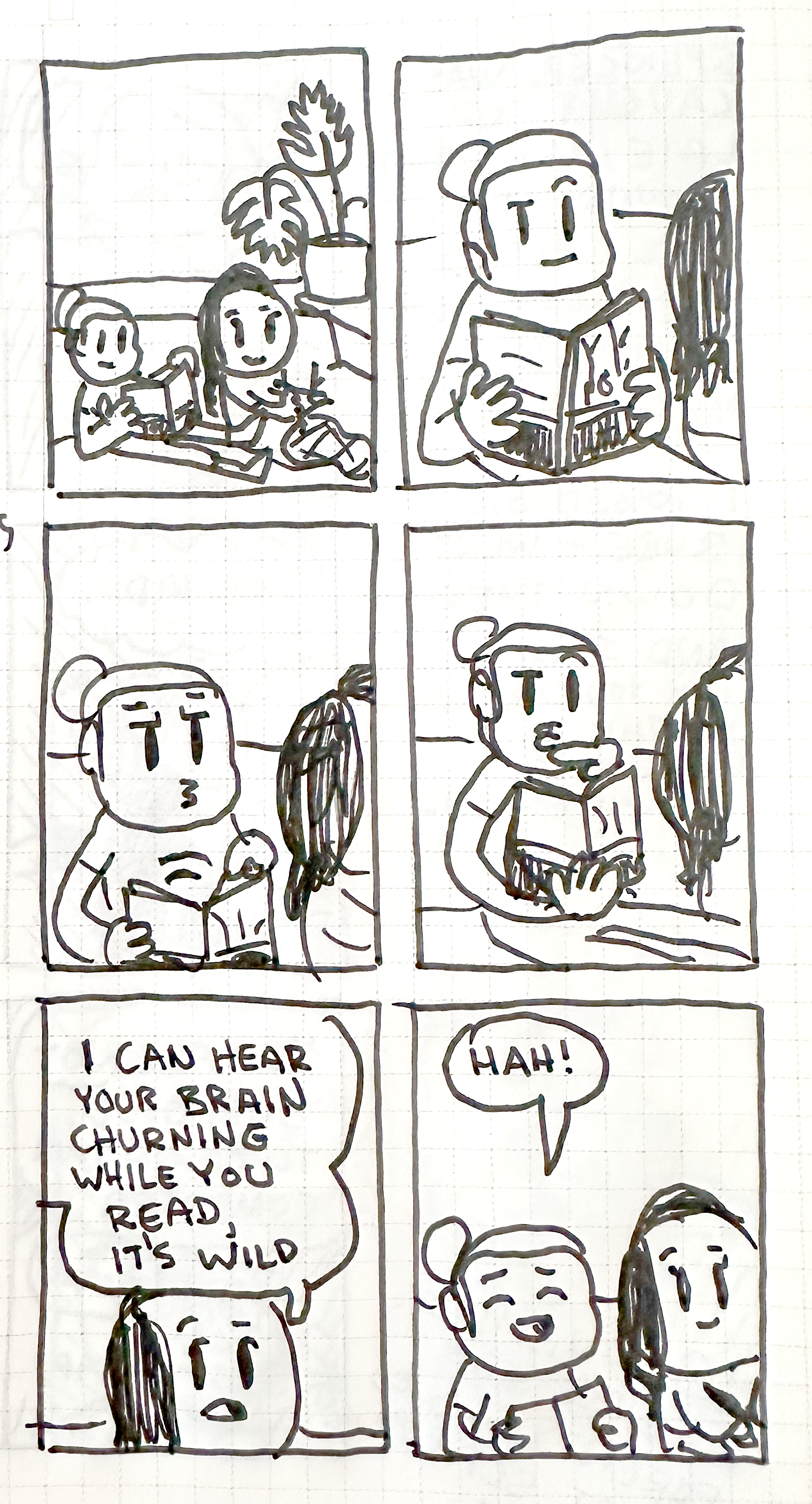
One of my favorite subjects to study/read about/talk about is art instruction. I looooove finding old books with process and technique clearly illustrated with diagrams and drawings to copy. I love the feeling of finding some old, obscure art book in a little free library or at a used bookstore - it's a little treasure, a gift from the universe. I once found a comb bound book on mid 1800's era furniture decoration and it filled my soul. It's so interesting to imagine getting into a particular creative medium at various times in the past, how the economic history of the time period either helped or hindered people getting into the arts in the first place.
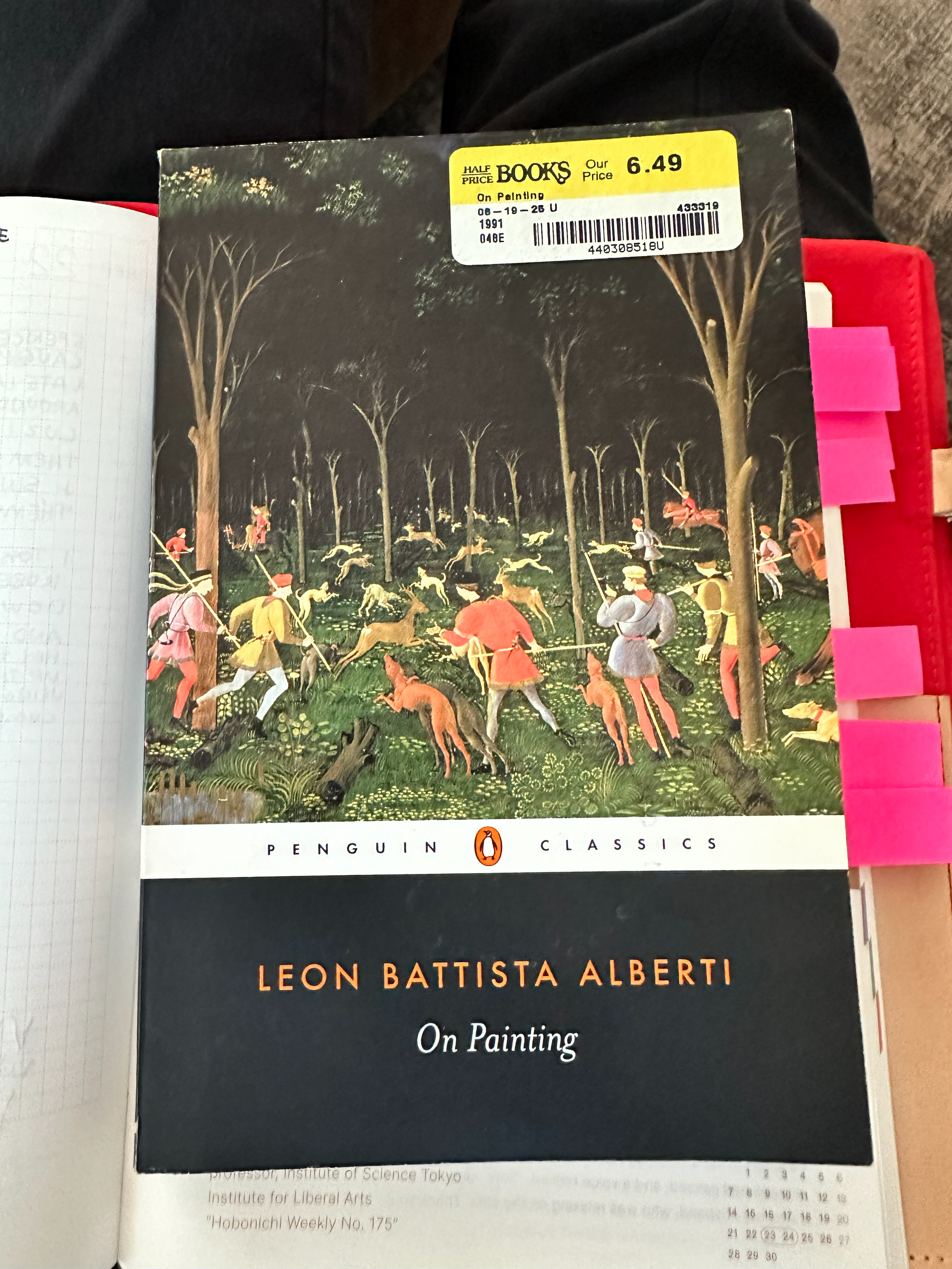
My most recent find was a $6.48 copy of On Painting by Leon Battista Alberti at Half Price Books. This is a Penguin Classics edition of a 1435 text (you read that correctly), purportedly the first real book written about painting as a thing to do. It's fascinating - I went to art school and got a degree and everything and don't recall being introduced to this book, but I can see ripples of how it influenced the way that people do painting instruction in academia all the way downstream to today.
In school when you are learning a new artistic medium you typically start from the beginning. You learn the basics, the history, the origins of the medium and then and only then can you do your own thing. Orthodoxy is where you start and then maybe at some point you start experimenting once you learn the basics, and then you grow and the medium grows and humanity is enriched by your participation in art.
Alberti was a pre-DaVinci era painter, who, in fact, directly influenced DaVinci's obsessively technical and science & math fetishistic painting and drawing style. It was the thing to be a "Renaissance Man" back in the Renaissance era, and while we think of DaVinci as the ultimate version of this, Alberti was the first. It was cool to be a multi-disciplinary genius of art back then, and in fact you kind of had to be good at things like geometry and physics because you were often not just painting or drawing but shaping the very urban landscape of where you lived. Alberti was responsible for a ton of architecture in Florence, Italy where he lived, and came up with basic mapping and perspective techniques that were useful in 2d and in 3d space. He was interested in optics, depth, and how light and color actually worked.
You can see Alberti's influence all over the Renaissance era, from frescoes in cathedrals to paintings by DaVinci and Botticelli and so forth. What I was fascinated by when I read it this time was how much philosophy and why Alberti discussed as part of his painting instruction.
In my coaching practice, I help people find their why as a place to start from. I believe that art and creativity is a universal good and that if you have any interest at all in contributing to one of humanity's greatest gifts to itself, then I want to help that flourish. You gotta get people hyped because motivation doesn't necessarily come naturally.
"There are... activities in which the powers of body and mind function together to bring profit. Such are the occupations of painters, sculptors, musicians and others like them. All these ways of making a living, since they depend mainly on our personal powers, are what you call arts, and do not go down in shipwrecks but swim away with our naked selves. They keep us company all our lives and feed and maintain our name and fame"
-- Alberti, On Painting
I am of the opinion that modernity is a myth, and that people in the past acted and felt and loved and created largely the same way we do now. I like thinking about how the socio-economic factors of different time periods affected people's ability to create, and in the Renaissance era one could make a living as a working artist because of the robust system of patronage that came not only from the church but from secular sources as wealthy patrons started commissioning more and more art to fill their grand homes. Alberti here is laying out a definition of art as it sits within commerce. He is suggesting a kind of nobility that comes from using your "personal powers" to create. As a working artist myself, this is something that drives me to my core. I don't want to be a cog in the capitalist system unless I'm getting something spiritually fulfilling out of it, and I want to encourage others to think that way too.
On Painting is split up into three "books" - the first being concerned with a definition of art and includes some mathematical and technical diagrams which have great utility. He describes using a net made of silk, tied off at regular intervals to make an array of squares, to measure out the dimensions of something you want to replicate at a larger or smaller scale. Basically he's describing using a grid overlay like you'd do in Photoshop. He goes on to explain that in his writing he is outlining the basic rudiments of painting, and encourages painters to explore beyond those rudiments. He also has some pretty strong opinions about the mindset a painter should be in, and what constitutes a "good" painter versus a "bad" one.
"I have outlined here, as a painter speaking to painters, only the first rudiments of the art of painting. And I have called them rudiments, because they lay the first foundations of the art for unlearned painters. They are such that whoever has grasped them properly will see they are of considerable benefit, not only to his own talent and to understanding the definition of painting, but also to the appreciation of what we are going to say later on. Let no one doubt that the man who does not perfectly understand what he is attempting to do when painting, will never be a good painter. It is useless to draw the bow, unless you have a target to aim the arrow at. I want us to be convinced that he alone will be an excellent painter who has learned thoroughly to understand the outlines and all the properties of surfaces. On the other hand, I believe that he who has not diligently mastered all we have sad, will never be a good artist." -- Alberti
WOOF. Gatekeeping? Maybe. I believe personally that anyone can become a good artist and that talent is a myth (it's just a mix of enthusiasm and effort) and while I don't think Alberti is saying "you can't be a good artist unless you know everything first" I think that maybe this is a sentiment that has been passed down academia and has caused psychological damage to many an art student who struggles with perfection. My project when tutoring or mentoring artists is to help them shed preconceived notions of what a "good" or "bad" artist looks like, and that often means unlearning concepts like this one. I do think it's a good target to shoot for once you have achieved some level of mastery, and I definitely can see how this was quite important in an age when painting supplies weren't as prolific as they are now. Setting out in 1435 to paint an oil painting on canvas requires considerable effort to get the materials, and you wouldn't want to waste them! What I take from this sentiment is that being prepared, understanding materials and how the natural world works before you set out to paint is important, and if you are setting out to paint a forest you should probably know a lot about trees.
This is also an era of realism and naturalism and humanism over symbology. Pre-Renaissance era paintings were mostly concerned with symbolism over naturalism, which is why when you see art from that era you'll see something weird like a Virgin Mary with a weird head and a Baby Jesus sitting on her lap who looks like a little full-grown man. So we're not necessarily talking about things like abstract art or "modern" art, but I do believe it's important to know the basics before you challenge them.
Book 2 has some great nuggets of wisdom, I especially enjoy this anecdote about valuing your works and the overall "value" of art:
" The painter Zeuxis began to give his works away, because, as he said, they could not be bought for money. He did not believe any price could be found to recompense the man who, in modelling or painting living things, behaved like a god among mortals." -- Alberti
Painting and creativity is loaded with so much virtue, you're basically behaving like a god! I love it. What a great way to think about creativity.
But what about creating for pleasure?
"I have always regarded it as a mark of an excellent and superior mind in any person whom I saw take great delight in painting. Although, this art alone is equally pleasing to both learned and unlearned, and it rarely happens in any other art that what pleases the knowledgeable also attracts the ignorant. You will not easily find anyone who does not earnestly desire to be accomplished in painting." -- Alberti
Ok, there are a couple things to unpack here. I love that he's saying that painting is virtuous because it is a pleasurable act. I believe as an artist that if you're not having fun you should stop and think about how to have fun, or hit the bricks. Honestly, if you're not having fun you're either in ditch-digging mode (my term for the parts of the creative process where you gotta prime your canvas, or gather materials... it's just labor that's laying the groundwork for the fun stuff) or you're pursuing something maybe you shouldn't. Life is about farting around (Vonnegut) and as artists we owe the ones consuming our art an emotional connection to the experience we had creating the art. This is one of the reasons why I deride generative AI art, it has no soul. A computer cannot have fun, so there can be no fun injected into the spirit of a piece. You can tell by looking when an artist wasn't having any fun making their art - mostly because it comes out poorer for it. Art is fun and creating is fulfilling on a fundamentally human level. It belongs to the humans.
Speaking of the grid system Alberti talks about - he refers to it here as a "veil" and talks about tool usage:
"I will not listen to those who say it is no good for a painter to get into the habit of using these things [tools], because, though they offer him the greatest help in painting, they make the artist unable to do anything by himself without them. If I am not mistaken, we do not ask for infinite labour from the painter, but we do expect a painting that appears markedly in relief and similar to the objects presented. I do not understand how anyone could ever even moderately achieve this without the help of the veil. " -- Alberti
One idea that I hear a lot from young artists and people learning how to draw is this concept that using tools is "cheating". Look. There is no "cheating" in art. The only "cheating" that happens when creating art is using someone else's efforts and claiming it as your own (as in the case with generative AI, which is not a tool. It is a service. ) Alberti is arguing here that the whole point of making a painting is to make one that accurately portrays the thing you're trying to portray, so measure things and use your tools and don't worry about people thinking you skipped a step there. Tracing a drawing isn't cheating. Using a grid isn't cheating. Photobashing isn't cheating.
I'll end this musing with a note about feedback. Another thing that people I mentor and other young artists deal with is an innate resistance to feedback. They just don't wanna hear it. Their heart can't take criticism, and would rather people just look at and praise the thing they made without feeling like they did something wrong, or need to toss out their hard work and start over again. It behooves the artist to deal with their internal biases, such as sunk cost fallacy, and really think about the goal of the piece they're creating.
"Therefore, a moderate diligence should be employed. Friends should be consulted, and while the work is in progress, any chance spectators should be welcomed and their opinion heard. The painter's work is intended to please the public. So he will not despise the public's criticism and judgement when he is still in a position to meet their opinion. They say that Apelles used to hide behind his painting, so that the viewers could speak more freely, and he could more decently listen to them enumerating the defects of his work." --Alberti
Listen to feedback! Feedback is a gift. It doesn't mean you're a bad artist or a bad person. When I do usability testing for designs in video games, I often tell people I wasn't the one who designed the thing I'm getting feedback on, so they don't worry about hurting my feelings when they're giving critical feedback.
"There is no one who does not think it an honour to express his opinion on someone else's work. Nor is there any need to fear that the judgement of censorious and envious critics can in any way detract from the merit of the painter. His fame is open and known to all, and his own good painting is eloquent witness to it. " -- Alberti
Everyone likes giving their opinion on things! But artists don't need to feel bad listening to criticism because it is actually kind of amazing to put in the effort to make something to begin with. It's easy to criticize than it is to create, so when you are sitting and getting feedback it's good to remember that the effort you made to create the thing is greater and more virtuous than the minimal effort it takes someone to criticize. This mindset can help you absorb the information better too, when you are resisting feelings of personal offence. I used to get so embarrassed and angry at people who would criticize my work, even when I knew it was bad! Gotta get over those feelings.
I don't honestly recall reading On Painting when I went to art school, though I imagine it was assigned reading during my painting track. It was so long ago at this point, who really knows. But I loved stumbling upon this book at the used book store and diving into a slice of history that I could connect to how I think about art instruction in the present day. There's so much to learn from the way people pass on the traditions of creativity.
Interested in 1:1 Creative Coaching?
I have a few slots open for new coaching clients, and I'd love to work with creators who are feeling a little burned out, who maybe want to pursue a new medium or find a new hobby. Email me or fill out a form at my Coaching Website if you want to learn more.